
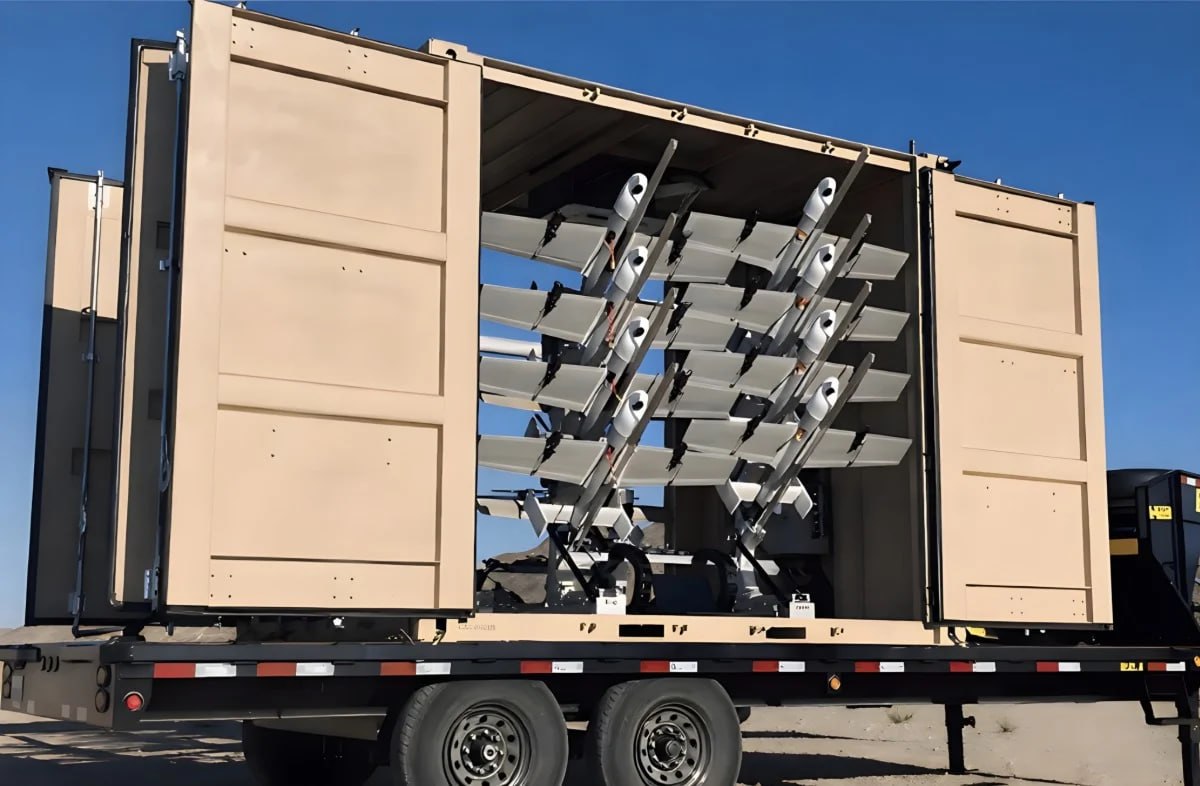
DZYNE Blitz containerized loitering munition and its implications for Asymmetric Warfare
The contemporary operational environment has demonstrated a definitive shift away from exclusive reliance on high-cost, low-volume “exquisite” platforms toward mass-deployable, autonomous, and cost-effective systems. This report examines the DZYNE Technologies “Blitz” loitering munition, focusing on its technical architecture, containerized deployment methodology (BlitzBox), and its approach to swarm coordination in heavily contested electromagnetic environments.
Recent conflicts have underscored the vulnerabilities of concentrated forces and traditional logistics chains. The demand signal from modern battlefields requires scalable, attritional assets that can overwhelm advanced air defense networks. The Blitz platform, developed by California-based DZYNE Technologies, addresses this requirement by merging a low-cost, fixed-wing unmanned aerial vehicle (UAV) with an ISO-standard containerized launch mechanism, effectively weaponizing standard global logistics infrastructure.
System Architecture and Specifications
The Blitz utilizes a twin-boom, fixed-wing airframe driven by dual electric motors integrated into the wings. The design prioritizes rapid field assembly and minimal logistical footprint over high-end performance metrics.
Performance Parameters:
- Maximum Takeoff Weight (MTOW): 6.8 kg
- Payload Capacity: Up to 2.3 kg (accommodating various kinetic warheads or sensor packages)
- Operational Range: 80 km (Standard); up to 150 km (Extended battery variant for one-way strike profiles)
- Endurance: 1 to 2 hours, dependent on battery configuration
- Cruising Airspeed: 74–139 km/h
Despite its operational range, the platform is designed for tactical mobility. A single unit breaks down into a standard 80-liter tactical pack and can be assembled and readied for launch by a single operator in under two minutes.
Modularity and C2 Interoperability
Flexibility at the tactical edge is a critical design feature of the Blitz. The airframe features hot-swappable components, including the nose section, wingtips, and empennage.
Crucially, the platform avoids proprietary lock-in regarding its communication architecture. Radio modules from various manufacturers are designed to slot directly into the vertical stabilizers, allowing units to rapidly cycle frequencies or upgrade hardware in response to emerging electronic warfare (EW) threats. The system operates on the open-source MAVLink protocol, and its ground control interface integrates directly with the Android Tactical Assault Kit (ATAK), ensuring seamless integration into existing Western infantry command and control (C2) networks.
Deployment Methodology: The BlitzBox
While the Blitz can be hand-launched or fired from a lightweight four-rail system, its primary strategic value lies in the “BlitzBox” launch module.
DZYNE has engineered multi-launch systems fitted entirely within standard 3-meter, 6-meter, and 12-meter ISO shipping containers. A single 12-meter (40-foot) container has the capacity to house over 100 fully assembled, ready-to-launch munitions, or up to 900 units in a disassembled state.
This containerized approach allows for profound logistical obfuscation. A BlitzBox can be transported via commercial flatbed trucks, rail, or maritime vessels, remaining visually indistinguishable from civilian cargo until the moment of launch. This capability enables rapid force projection and the establishment of covert strike capabilities in operationally unpredictable vectors.
Swarm Mechanics and EW Resilience
A persistent challenge in autonomous UAV operations is maintaining swarm cohesion under intense EW jamming. While many platforms rely on active mesh-networking for real-time inter-drone communication, such links are highly susceptible to disruption.
DZYNE’s architecture adopts a pragmatic approach to swarm operations. Rather than utilizing active data exchange between airframes, the Blitz executes coordinated, pre-programmed time-on-target strikes. A high-volume launch (e.g., 100+ units from a BlitzBox) relies on synchronized flight paths programmed prior to launch.
Furthermore, the system is capable of operating in a fully autonomous, radio-silent mode. By relying on internal waypoints and inertial navigation without an active command link, the platform minimizes its electromagnetic signature, effectively neutralizing the efficacy of standard RF jamming equipment.
Economic Asymmetry
The strategic viability of the Blitz system is anchored in its unit economics. At a stated cost of under $10,000 per unit (excluding the warhead), and with a projected manufacturing output of up to 5,000 units per month, the platform is explicitly designed for wars of attrition.
This pricing structure imposes a severe cost-exchange penalty on adversaries. Defending against a localized saturation attack of hundreds of Blitz munitions necessitates the expenditure of sophisticated surface-to-air effectors (e.g., interceptor missiles), which routinely cost hundreds of thousands to millions of dollars per unit. This forces a rapid depletion of adversary air defense magazines at a financially unsustainable rate.
The DZYNE Blitz represents a maturation in loitering munition design, moving beyond individual platform capabilities to focus on mass deployment and logistical integration. By combining sub-$10k unit costs, EW-resilient autonomous targeting, and the covert launch capacity of standard ISO containers, the system offers a scalable method to saturate and degrade modern layered air defense networks.